SAEON Graduate Student Network
On the 1st of September, the picturesque setting of Qwantani unfolded as the backdrop for the 17th SAEON Graduate Student Network gathering of Master’s & PhD students. With 33 eager students hailing from universities across South Africa, the event promised a blend of knowledge-sharing, collaboration, and inspiration.
As the sun rose, casting golden rays over the serene landscape, the students arrived, greeted by the gentle rustle of leaves and the distant sounds of birds. The atmosphere buzzed with excitement as they exchanged introductions, each sharing their unique research interests and backgrounds. From marine biology to ecological conservation, the diversity of topics sparked lively discussions.
Sue van Rensburg shared insights on SAEON terrestrial research. Dr. Phumlile Cotiyane-Pondo presented on SAEON’s South Africa Polar Research Infrastructure (SAPRI) & Shallow Marine Coastal Research Infrastructure (SMCRI). Dr. Michelle Tedder discussed the value of long-term grassland monitoring, and Dr. Robin Nicolay presented on soil carbon dynamics.
Nicole du Plessis spoke about ocean governance and Blue Economic opportunities for students. Professor Fhumulani Mathivha addressed the management of climate-driven hydrological extremes. Dr. Emma McKinley concluded the series with a presentation on the role of marine social sciences in informed global decision-making. Dr. Amukelani Maluleke shared his personal science journey with students before facilitating the carbon flux workshop, which was an excellent opportunity for students to understand the dynamics of EFTEON’s research infrastructure before going on the field trip.
They shared insights about the challenges facing South Africa’s ecosystems and the critical role young researchers play in addressing these issues. The students listened intently and shared ideas during the question-and-answer section.
Students, before the conference, attended an online science communication training and were placed in syndicate groups to create a product for a non-technical audience using SAEON research papers. During the conference, students presented engaging plays, videos, and materials that they created for a non-technical audience.
We dedicated one day to field trips to expose students to the research conducted in the northern Drakensberg, where the SAEON Grassland Node and EFTEON carry out most of their work. The Drakensberg Mountains are well known as the “water towers,” with the uTugela catchments providing a variety of ecosystem services. Our first stop was at the Drakensberg Pumped Storage Scheme, where delegates learned about the role of water in electricity generation and storage. In addition to water management, students were introduced to the plant’s infrastructure, history, and the different departments within Eskom, spanning production, transmission, and substations.
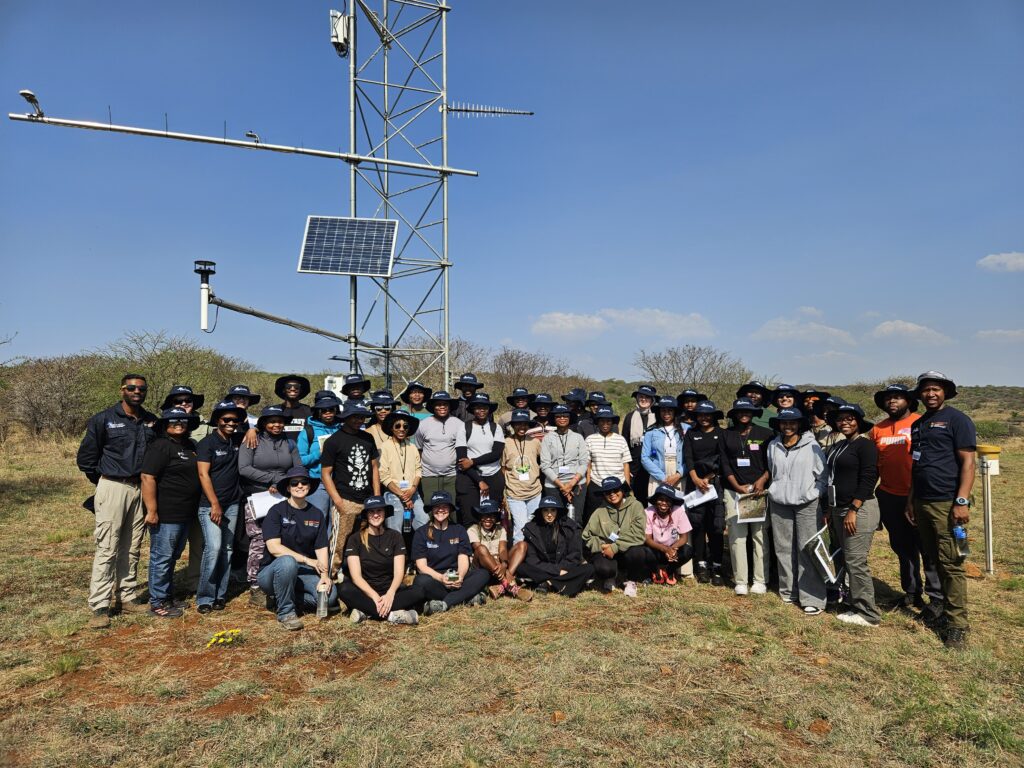
Thereafter, students were taken to the EFTEON Research Site at Spioenkop Nature Reserve, which hosts much of EFTEON’s infrastructure. The EFTEON team, led by Dr. Kathleen Smart and Grassland Node hydrologist Dr. Michele Toucher, introduced delegates to a range of research activities, including biogeochemistry, biodiversity monitoring, and eddy covariance studies. A major highlight was the technologically advanced equipment used by EFTEON, including upgraded weather stations, eddy covariance towers, and acoustic monitoring devices. Most delegates gained an understanding of how data is collected and made accessible by technicians such as Dr. Amukelani Maluleke and Sachin Doarsamy.
Congratulations to the outstanding presentation award winners at the 17th SAEON GSN Indibano. Ameera Yacoob of the Grassland Node won the top award for her presentation, “Machine Learning Approach for Quantifying Crop Water Stress in Smallholder Farms Using Unmanned Aerial Vehicle Multispectral Imagery.” Lindani Sifanele achieved second position for his research on “Homestead Hedges as vectors for invasive species and poisonous plant species in rural and urban communities in the central Eastern Cape.” Karabo Moloi was awarded third position for the presentation, “Mapping the Current and Future Distribution of Invasive Alien Shrubs in South Africa’s High-Elevation Grasslands.”
A networking Bingo game was a featured activity designed to foster interaction among the delegates. The game encouraged participants to mingle and connect with their colleagues by finding individuals who matched specific criteria on their bingo cards. This light-hearted competition provided a fun and engaging break from the intensive learning schedule, successfully facilitating new conversations and professional connections throughout the week. A big congratulations to Naledi Manyaka for winning the game.This year’s GSN Indibano included a fun and meaningful competition, an iNaturalist challenge to see who could contribute the most biodiversity observations to iNaturalist. iNaturalist is a global citizen science platform that allows anyone to document the natural world around them, such as plants, animals, and other organisms. Each observation contributes to an improved understanding of the biodiversity of an area.
During free time and on the fieldtrip to Spionkop Nature Reserve, students explored their surroundings, capturing and sharing the unique biodiversity of the Northern Drakensberg. Together, they added 121 new observations to the iNaturalist database through the GSN Indibano 2025 project. This challenge also feeds into broader citizen science initiatives, such as EFTEON’s iNaturalist project , which uses citizen observations to complement ongoing long-term research in its landscapes across the country. One of these is the Northern Drakensberg Landscape, which includes Spionkop Nature Reserve, meaning that the GSN Indibano observations directly contribute to EFTEON’s efforts to build a deeper understanding of biodiversity in the area. A big congratulations to Mayibongwe Butelezi, the winner of the NRF-SAEON GSN Indibano 2025 iNaturalist challenge!
One memorable evening, a bonfire brought everyone together under the starlit sky. Laughter echoed through the night as they recounted their journeys, struggles, and dreams. Friendships blossomed, with promises to stay connected beyond Qwantani. As the gathering drew to a close, the students reflected on their experiences. The connections made, the knowledge gained, and the inspiration ignited would resonate far beyond the event. They left Qwantani not just as individual researchers but as a community, united by a shared commitment to the environment and a vision for a sustainable future.
In the weeks that follow, we envisage the impact of the 17th NRF-SAEON GSN Indibano gathering will ripple through their universities. Ideas sparked collaborations, and many students will begin new projects inspired by the discussions at Qwantani. The 17th SAEON Graduate Student Network gathering was not just an event; it was a catalyst for change, empowering the next generation of environmental scientists across South Africa.